October 13th, 2026
news
What it takes to bring offshore power transfer to the world
What it takes to bring offshore power transfer to the world
Gordon Dickson, Stillstrom’s Operations and Maintenance Lead, takes us behind the scenes of how an idea becomes an international standard
The offshore wind sector understands electrification, but what it is less familiar with is the international process that will make offshore power transfer a global standard, one that allows vessels to connect to offshore power anywhere in the world. This process is long, collaborative and not without its hurdles. After years of development, the expert group working under International Electrotechnical Commission (IEC) Technical Committee 18 (TC 18) has reached a significant milestone, and Stillstrom has been central to getting it there.
In June, the group concluded its technical work on a new offshore power transfer standard. The outcome is a Committee Draft, the first formally agreed document in the IEC's standardisation process, which has since been circulated to national committees around the world for comment. It marks the point at which a proposal becomes something the international community is actively working towards.
Getting there took longer than drafting the document itself. Here is a rundown to explain why:
1. How the IEC process works
The not-for-profit IEC develops standards through a system of national committees and technical working groups. IEC TC 18 covers electrical installations in ships and offshore structures, and it is within that committee's scope that offshore power transfer sits. Each member country has its own national mirror committee. Those committees vote, submit comments and send experts to in-person meetings. Nothing moves without consensus.
The starting point for the offshore power transfer standard was a white paper developed by Norway's national standards body, NEK (the Norsk Elektroteknisk Komité), drawing on Stillstrom's technical expertise. This white paper was submitted as the working draft, effectively fast-tracking the early stages of the process by giving the expert group an agreed technical foundation to build from rather than a blank page.
National committees then had the opportunity to submit comments on that draft. Those comments were resolved at June’s expert meeting, and the text has been consolidated into the Committee Draft and circulated within the IEC for review.
2. What a Committee Draft means
A Committee Draft is not a finished standard, it’s an endorsement by the expert group that the approach is sound, the technical content is agreed in substance, and the work should continue. There will be further rounds of review and voting before the document is published international standard,
and that process is likely to take until at least 2028 . But the Committee Draft is the first moment at which the direction is formally set.
For the industry, this matters for a practical reason. The draft closely follows the NEK white paper, which is already publicly available. Vessel operators, wind farm developers and equipment manufacturers can now look at that document and understand, with reasonable confidence, what the eventual standard will require. The technical core is established, now, what remains is process.
3. Why this is broader than one company's technology
Stillstrom is the only organisation currently active in the TC 18 working group with hands-on experience of testing offshore power transfer systems This position carries responsibility as much as opportunity. The standard being developed cannot simply reflect how Stillstrom does things, it has to work for unmanned supply points, for remote switching, for a range of vessel configurations and sea conditions. The expert group includes switchgear designers, ship operators and representatives from national committees across multiple countries, each of whom brings legitimate technical input even where their background is in shore power rather than offshore applications.
This breadth is what makes the process slow, but it is also what makes the outcome credible.
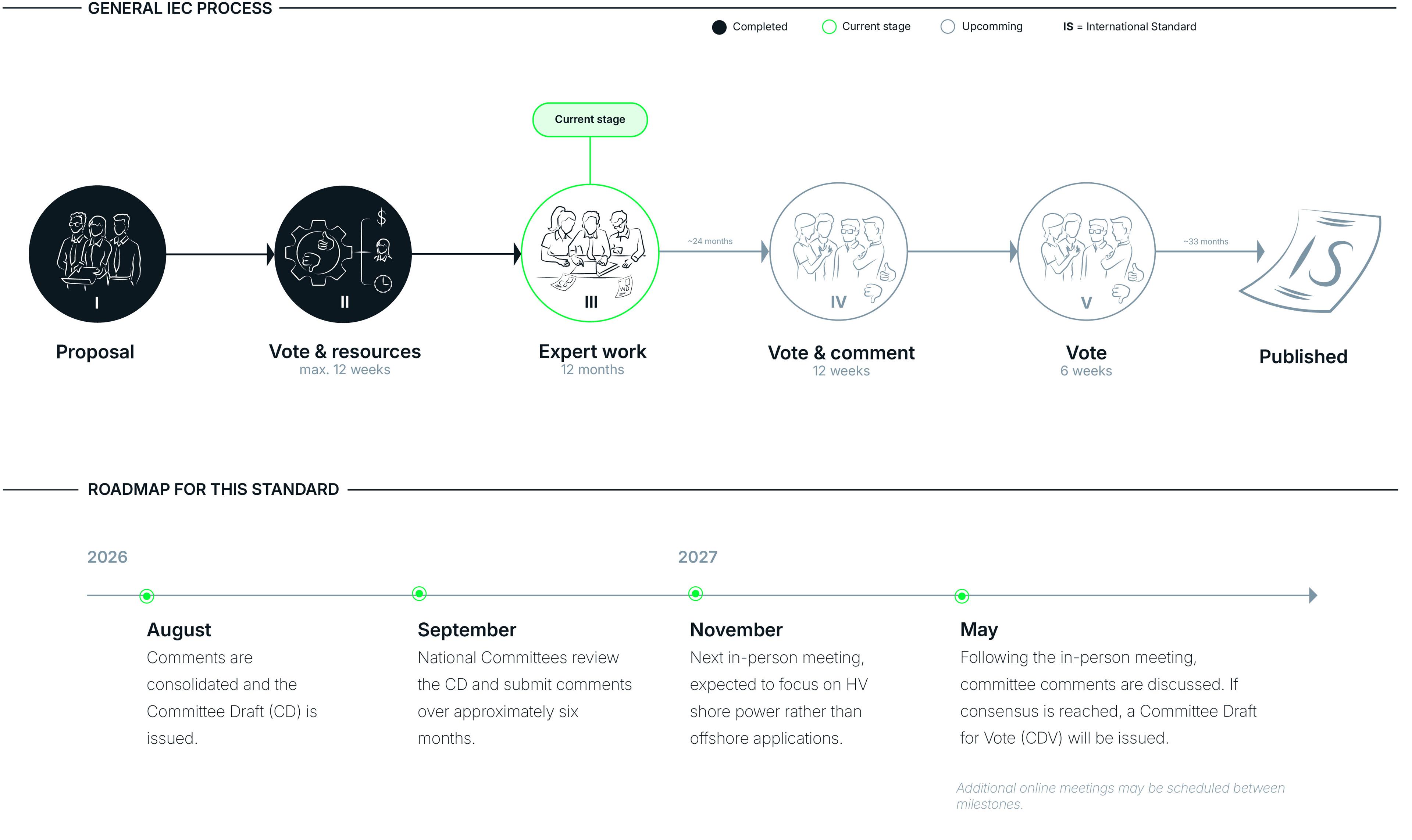
The IEC does not publish standards quickly, the process from proposal to international standard typically spans around 33 months, and this timeline assumes steady progress and no significant disagreement at the voting stages. The offshore power transfer standard is moving at a reasonable pace, in part because it draws heavily on the existing shore power standard and in part because there has been genuine consensus amongst the expert group on the technical approach.
4. What comes next
Once the Committee Draft is circulated, national committees will have approximately six months to submit comments. The next in-person meeting of the working group is planned for November this year, though the agenda at this stage is expected to focus primarily on updates to the high-voltage shore power standard. The more substantive discussion of the offshore draft is likely to take place at the May 2027 meeting, at which point, if consensus holds, the group could move to a Committee Draft for Voting.
This step, known as a CDV, is the point at which the international community formally votes on whether the standard should proceed to final draft. It is the clearest signal yet that a document is close to becoming published .
The publication of an international standard is the moment the industry can point to a document and say, this is how offshore power transfer is done. We are not there yet, but the expert group has agreed on the substance, the process is running to schedule - and the technical foundation is solid.
For anyone working in offshore wind or maritime electrification who wants to understand what is being developed, the NEK white paper remains the best available reference. The Committee Draft, when circulated, will follow it closely. Read Stillstrom’s previous blog explaining why offshore electrification needs a standard here.
ENDS
Media Enquiries
Issued by BIG Partnership on behalf of Stillstrom.
About Stillstrom by Maersk
Stillstrom by Maersk is at the forefront of decarbonising the maritime sector with its pioneering offshore power and charging solutions. The company’s mission is to reduce vessel emissions, the largest source of CO₂ in the offshore wind supply chain. Its integrated charging systems enable hybrid and electric vessels to plug into low-emissions electricity while offshore.
Owned by Maersk, the business was founded in 2019 as an innovation project and became an independent company in 2022. The company employs more than 30 people at its headquarters in Copenhagen (Denmark) and Aberdeen (UK).